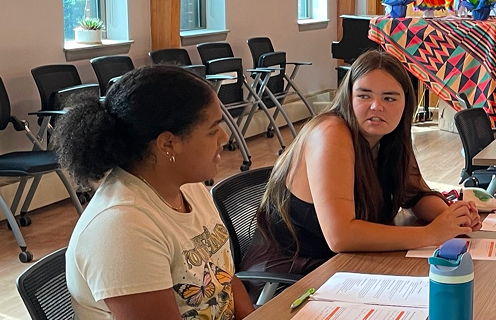
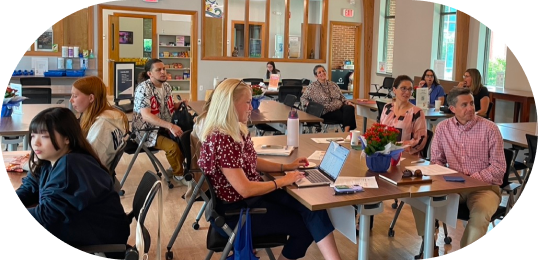
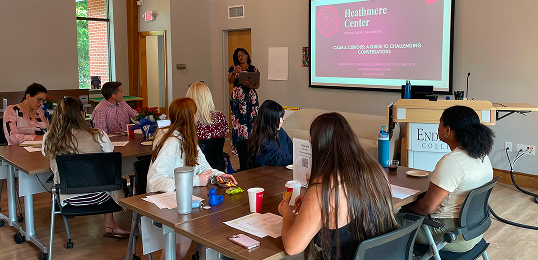
Heathmere’s in-school programs offer practical civic and humanities-based skills-building opportunities that improve students’ ability to navigate relationships anywhere. Students are encouraged and supported to listen to understand, explore perspectives different from their own, and engage with honesty and sensitivity even when conversations get hard. Our professional development for school educators helps them create classrooms where students and teachers communicate more genuinely and confidently.
Our Approach
Deep Listening and Sincere Inquiry
In our fast-paced culture, listening is often undermined by our tendency to focus on what we’ll say next. Through our workshops, students slow down and listen attentively—responding with genuine curiosity and resisting the tendency to debate or defend. Students learn to notice when their own assumptions or emotional reactions prevent them from pursuing a deeper understanding of someone else’s thinking. Instead of waiting to “make their point,” students develop the capability to ask questions that open conversations and help everyone get to the heart of the matter.
Identity and Perspective Awareness
We all see the world through the lens of our own experiences — shaped by where we grew up, how we were raised, and who we are. Our interactive exercises help students understand the impact of social identities and assumptions—their own and others. They explore how identity influences the way people interpret history, current events, and opportunities to influence decisions that affect their lives and livelihood. In contrast to cancel-culture, this work invites students in, giving them a richer, more expansive framework for understanding the world and the people in it.
Brave and Trusting Spaces
Meaningful conversation requires the courage to express one’s views honestly and authentically. Heathmere helps students build that kind of learning environment together. Establishing shared agreements about how they’ll engage is a critical first step that enables collaborative and courageous practice. As students speak from their own experience and sit with the discomfort of engaging real difference, they also embrace learning as an ongoing process. The goal isn’t agreement. It’s the ability to create brave and inclusive spaces that invite multiple viewpoints and deeper connections.
What Students Said They Learned
from in-school dialogue workshops
“Questions are powerful tools for connecting and gaining perspectives; I learned that curiosity is an amazing way to learn more about others and yourself; I learned how to identify questions that are connective versus those that may make people take a defensive stance”
“I feel like I know myself and who I am now in conversation”
“To be open, mindful, and respectful of a diversity of perspectives and how to respectfully investigate the background behind them”
“To accept and welcome silence in discussions”
“I learned a lot from being able to listen to other people’s opinions on topics we might not otherwise discuss. Being put in a situation where the whole point is to listen thoughtfully, not proving your point is very different from the classroom environment”
“How to share my own opinion even when others differ from my own”
“To understand how my privileges create my biases”
“To notice the importance of asking questions and the time to take in reflection before asking them”
“How to listen better instead of think about what I need to say. I’ve also got much better at asking questions instead of just making statements”
“I saw vulnerability from my peers that arose out of these discussions, that was awesome”
Bring Heathmere to Your School
Contact us today to learn how Heathmere can design a customized program for you!